

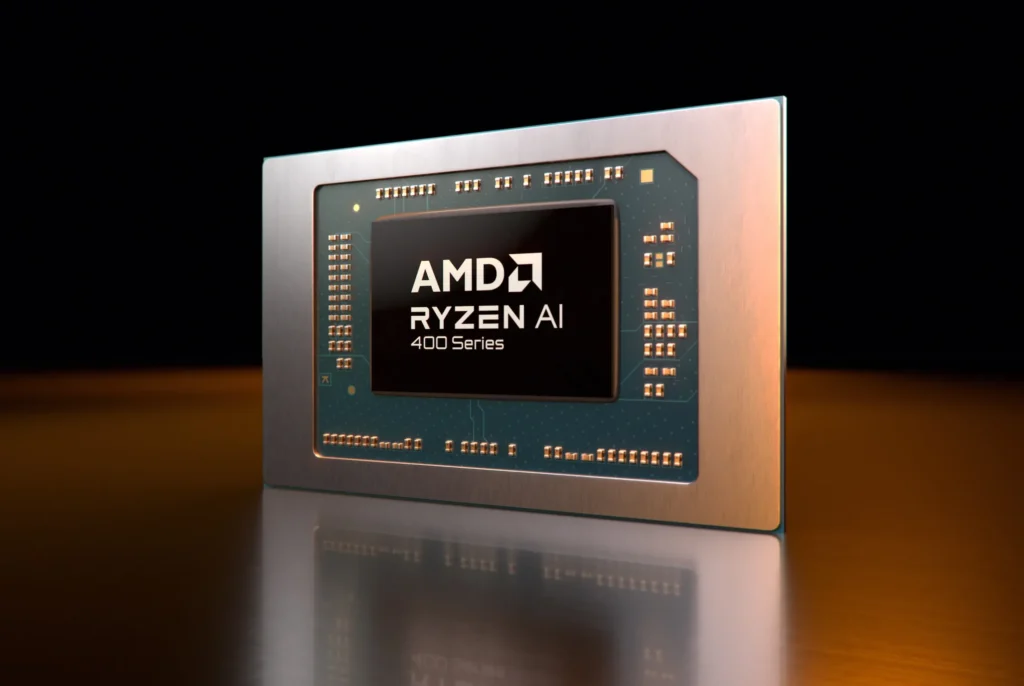
At CES 2026, AMD CEO Dr. Lisa Su unveiled the Ryzen AI 400 Series processors, a significant refresh aimed at powering next-generation Copilot+ PCs with enhanced AI capabilities.
Alongside this, AMD detailed its aggressive expansion in the data center space, revealing the full Instinct MI400 Series accelerator lineup and providing an early look at the rack-scale Helios platform, positioning the company to challenge Nvidia in the booming AI infrastructure market.
Ryzen AI 400 Series: Next-Gen AI for Laptops and Desktops
The Ryzen AI 400 Series, codenamed “Gorgon Point,” builds on the successful Ryzen AI 300 Series foundation with meaningful upgrades in clock speeds, memory support, and NPU performance. These processors target premium laptops, ultra-thin notebooks, mini-PCs, and—for the first time—desktops, marking AMD’s entry into Copilot+ certified desktop computing.
Key Features and Specifications
Powered by Zen 5 CPU cores, RDNA 3.5 integrated graphics, and the advanced XDNA 2 NPU architecture, the series delivers up to 60 TOPS of AI performance on flagship models like the Ryzen AI 9 HX 475. This represents a notable increase from the previous generation’s 50 TOPS maximum, ensuring compliance with Microsoft’s Copilot+ requirements while outperforming competitors in raw AI compute.
The lineup includes seven mobile SKUs, ranging from the high-end 12-core/24-thread Ryzen AI 9 HX 475 (with Radeon 890M graphics and up to 3.1 GHz GPU boost) to more efficient options like the Ryzen AI 5 430. Higher-tier models support DDR5 memory speeds up to 8533 MT/s, enabling faster multitasking and content creation.
AMD claims significant gains over rivals, including up to 1.3x faster multitasking and 1.7x improved content creation performance at comparable power levels. Gaming sees an average 12% FPS uplift at 1080p low settings across popular titles.
Enterprise and Pro Variants
The Ryzen AI PRO 400 Series caters to business users with enhanced security, manageability, and stability features powered by AMD PRO technologies. These chips are designed for modern IT environments, offering multilayered protection without compromising performance.
Availability and Ecosystem
Systems from major OEMs including Acer, Asus, Dell, HP, Lenovo, and others will launch starting in Q1 2026 for laptops and mini-PCs, with desktop variants following in Q2 2026. AMD also expanded the Ryzen AI Max+ Series (Strix Halo) with new models like the Max+ 392 and 388 for premium ultra-thin devices and workstations.
Supporting the hardware, AMD introduced ROCm 7.2 software with full support for the Ryzen AI 400 Series on Windows and Linux, facilitating seamless AI development and deployment.
AMD’s Data Center Push: Instinct MI400 Series and Helios Platform
AMD reinforced its data center ambitions by unveiling the complete Instinct MI400 Series portfolio, including the new MI440X for enterprise on-premises deployments, alongside the previously announced MI430X and MI455X variants.
Instinct MI400 Series Highlights
Built on the CDNA 5 architecture, the MI400 family targets diverse AI and HPC workloads:
- MI455X — Powers massive scale-out systems with industry-leading memory capacity.
- MI440X — Optimized for enterprise training, fine-tuning, and inference in compact 8-GPU configurations that integrate into existing infrastructure.
- MI430X — Focuses on high-precision scientific computing and sovereign AI applications.
These accelerators will drive supercomputers worldwide, including projects at Oak Ridge National Laboratory and France’s exascale systems.
Helios Rack-Scale Platform
AMD showcased Helios, a groundbreaking rack-scale AI solution integrating 72 Instinct MI455X accelerators, next-gen EPYC “Venice” CPUs (Zen 6-based), and Pensando Vulcano NICs for high-speed networking. Unified by the open ROCm ecosystem, Helios promises exceptional performance, efficiency, and scalability for yotta-scale AI factories, with deployments starting in Q3 2026.
AMD also previewed the Instinct MI500 Series, slated for 2027, claiming up to a 1,000x AI performance leap over the MI300X generation.
Benefits and Competitive Positioning
The Ryzen AI 400 Series democratizes powerful on-device AI, offering multi-day battery life, superior gaming, and productivity in thin-and-light form factors. In data centers, AMD’s expanded portfolio challenges Nvidia’s dominance, with partnerships like OpenAI underscoring growing adoption.
These announcements highlight AMD’s comprehensive AI strategy—from edge devices to hyperscale clouds—driving efficiency, openness, and innovation across the ecosystem.
In summary, AMD’s CES 2026 reveals solidify its leadership in AI computing, delivering cutting-edge processors for consumers and enterprises while accelerating its data center momentum toward trillion-dollar market opportunities.